On March 26, 2026, a report came out that quietly shook Canada’s procurement world.
In a scathing review of the federal Indigenous procurement strategy, Procurement Ombud Alexander Jeglic described a system suffering from “fragmented guidance, inconsistent application and oversight, and missed opportunities to uphold the Strategy’s core objective.”
The report raised concerns about weak oversight, inconsistent verification, poor tracking systems, and even the possibility of shell companies improperly accessing Indigenous procurement opportunities.
One line especially stuck with me:
“People need to step forward with solutions.”
Honestly, I think that sentence perfectly captures where Canada is right now. Because over the last couple years, I’ve spent a lot of time sitting in rooms with very intelligent people trying to figure out how to improve Indigenous participation in Canada.
Government people.
Construction leaders.
Procurement teams.
Consultants.
Project managers.
And contrary to what social media sometimes wants people to believe, I don’t think most of these people are malicious or intentionally negligent.
Far from it.
Most genuinely want to do the right thing.
But what I’ve noticed is that there’s often a massive gap between intention and operational clarity.
Politicians talk about increasing Indigenous inclusion.
Governments introduce procurement targets.
Organizations publicly commit themselves to reconciliation and Indigenous economic participation.
And to be fair, the direction from leadership is becoming increasingly clear.
Prime Minister Mark Carney has repeatedly spoken about Canada entering a new era of nation-building, infrastructure investment, economic resilience, and what he calls “building our strength at home.”
In his World Economic Forum speech earlier this year, he talked about the need for Canada to stop “living within the lie” of outdated systems and assumptions. He argued that the country needs to stop pretending old structures still work simply because they’re familiar.
That idea really resonated with me.
Because honestly, I think a lot of organizations are experiencing exactly that tension right now.
They know the old way of managing Indigenous participation isn’t sustainable anymore.
But they also don’t fully know what the new operational model is supposed to look like yet.
And that uncertainty creates hesitation.
I remember sitting in one meeting in particular where the conversation kept circling the same issue over and over again:
“How do we actually do this?”
Not theoretically.
Operationally.
How do you track Indigenous participation properly?
How do you verify it fairly?
How do you manage subcontractors consistently?
How do you ensure accountability without slowing projects down?
How do you avoid mistakes?
How do you prove outcomes later during audits or reporting reviews?
And what struck me was this:
The people in the room were not incompetent.
Far from it.
Most were highly experienced operators managing incredibly complicated projects with enormous pressure attached to them.
But Indigenous participation is still relatively new territory operationally for many organizations.
The path is being built in real time.
That’s important to acknowledge.
Because I think many people underestimate how difficult it is to operationalize a major cultural, economic, and procurement shift across an industry that has historically operated very differently.
Construction operators already deal with:
- scheduling pressure,
- labour shortages,
- procurement complexity,
- safety compliance,
- budget risk,
- reporting obligations,
- subcontractor coordination,
- and constant project changes.
Now layer Indigenous Participation Plans on top of all that.
Not just as symbolic commitments but as measurable, reportable, auditable obligations tied to procurement scoring, project outcomes, and public accountability.
That changes the operational reality significantly.
And when human beings feel uncertain, they tend to fall back toward what feels familiar.
The systems they already know.
The workflows they already trust.
The habits they’ve used for twenty years.
Not because they’re bad at their jobs.
Because they’re afraid of failure.
Honestly, most of us are.
Wharton organizational psychologist and bestselling author Adam Grant has spoken extensively about this tension between expertise and adaptation in modern organizations. One idea of his especially stuck with me:
“The hallmark of expertise is no longer how much you know. It’s how well you adapt.”
I think that perfectly describes where Canada is right now when it comes to Indigenous participation and procurement.
Because the challenge isn’t necessarily a lack of intelligence or effort.
The challenge is that the operational environment has changed faster than the systems supporting it.
I think that’s one of the most misunderstood parts of this entire conversation.
A lot of operators aren’t resisting Indigenous participation itself.
They’re resisting operational uncertainty.
There’s a difference.
People become hesitant when:
- The rules feel unclear,
- Verification processes feel inconsistent,
- Reporting expectations keep evolving,
- And there’s fear of reputational or contractual consequences for getting things wrong.
That’s exactly why the Procurement Ombud report hit so hard.
Because it validated what many people in the industry were already quietly feeling:
the expectations are growing faster than the operational infrastructure supporting them.
And I don’t say that critically.
I actually think this is what transformation looks like in real life.
Messy.
Uneven.
Uncomfortable.
Built in real time.
That’s why I believe Indigenous businesses have such an important role to play right now.
Government can create direction.
Policy can create pressure.
But Indigenous entrepreneurs and Indigenous-owned businesses are often the ones building the actual operational pathways that allow these goals to function in reality.
That role matters enormously.
Especially because Indigenous participation is no longer just a policy discussion.
It’s becoming operational infrastructure for modern Canadian projects.
And I think we’re still early in understanding what that actually means.
For years, Indigenous Participation Plans were often treated like procurement attachments.
Something completed during bidding.
Then filed away.
But once you spend enough time around large infrastructure projects, you realize that participation is not static at all.
It evolves constantly.
Scopes change.
Budgets move.
Subcontractors rotate.
Training commitments shift.
Documentation requirements expand.
Community relationships evolve over time.
Which means Indigenous participation cannot realistically be managed through scattered spreadsheets, PDFs, email chains, and disconnected folders anymore.
Not at scale.
Research from the University of Hawaii found that 88% of spreadsheets contain errors. Yet many organizations are still attempting to manage highly complex Indigenous Participation Plans using fragmented spreadsheets, PDFs, and manual reporting workflows.
At some point, operational complexity exceeds the tools being used to manage it.
And when that happens, organizations lose confidence in the numbers.
That’s when the emotional tone changes inside projects.
Suddenly the questions become:
“Was this verified?”
“Do we have documentation for this?”
“Did this count properly?”
“Can we prove this later?”
“Who approved this?”
“Where are the invoices?”
“Did the subcontractor upload the reporting?”
That’s not where you want teams operating from.
Reactive administration creates stress.
Structured systems create confidence.
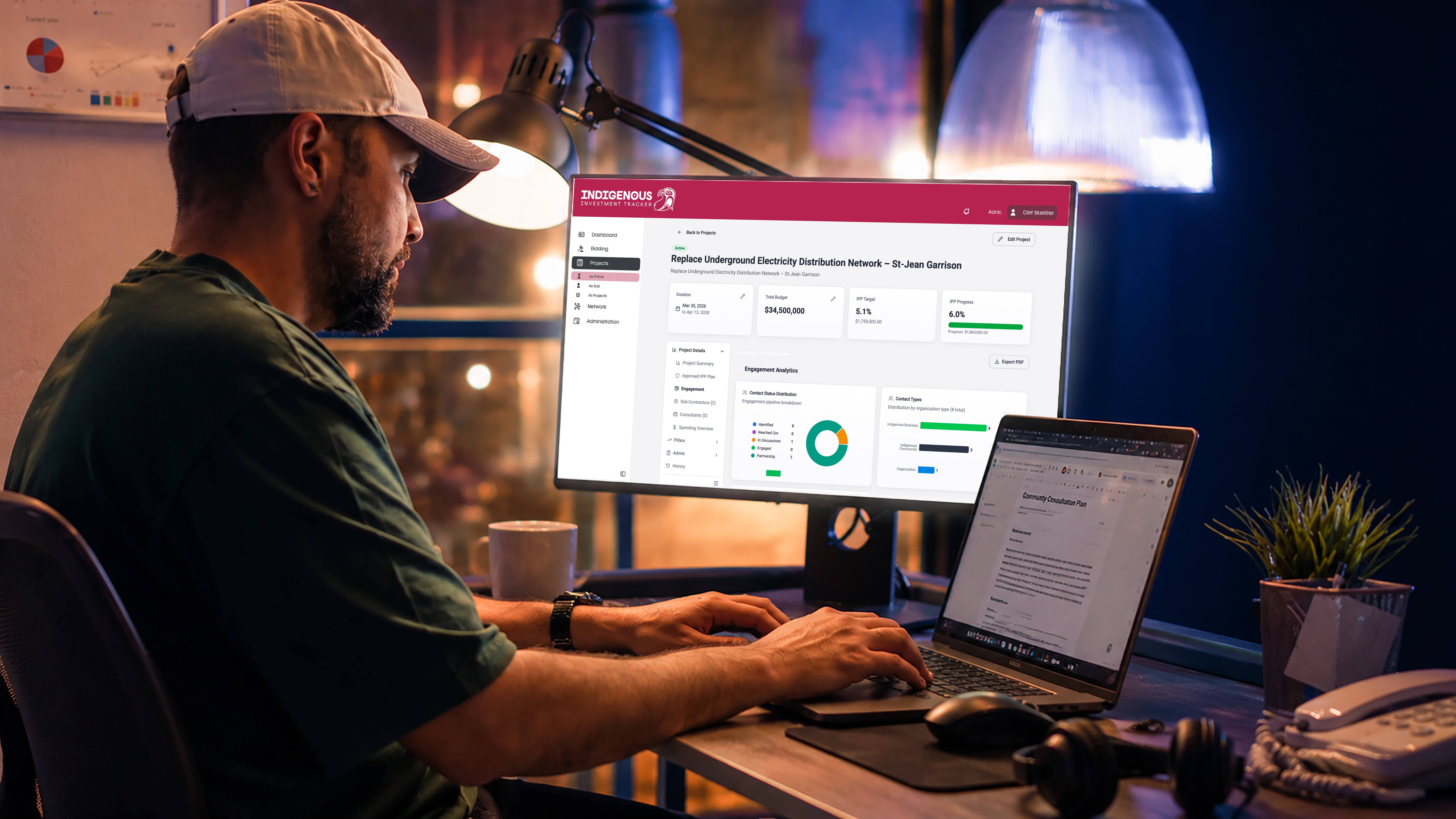
That’s one of the biggest lessons I’ve learned building the Indigenous Investment Tracker.
Originally, I thought the challenge was mostly about reporting.
But the deeper we got into conversations with contractors, Indigenous partners, procurement teams, and project managers, the more I realized the real issue was operational confidence.
People want clarity.
They want visibility.
They want consistency.
They want systems that help them move from reactive participation toward structured participation.
And honestly, that’s what built-for-purpose software really does.
It doesn’t magically solve human problems.
But good operational systems reduce uncertainty.
They create:
- Visibility,
- Accountability,
- Consistency,
- Auditability,
- And trust in the process itself.
That matters.
Especially in an environment where Canada is simultaneously trying to:
- Build faster,
- Increase Indigenous participation,
- Modernize procurement,
- Improve accountability,
- And strengthen domestic economic resilience.
Those are ambitious goals.
Good goals, in my opinion.
But ambitious goals require operational infrastructure underneath them.
Otherwise organizations get stuck in fear.
And fear creates paralysis.
That’s part of why Mark Carney’s speech resonated with me so strongly when he said:
“Nostalgia is not a strategy.”
Because I think Canada is entering a period where we have to stop pretending old systems are sufficient for new realities.
We cannot ask industries to modernize while expecting them to manage increasingly complex participation frameworks through disconnected administrative tools.
That’s not modernization.
That’s improvisation.
And honestly, I think the organizations that figure this out early are going to lead the next era of Canadian infrastructure.
Not because they’ll have the best slogans.
Not because they’ll write the nicest policy statements.
But because they’ll build operational maturity around Indigenous participation before everyone else does.
A major RBC report on reconciliation and industry relationships warned that companies failing to build strong Indigenous partnerships risk:
- Project delays,
- Litigation,
- Reduced investment confidence,
- And weakened long-term growth opportunities.
Meanwhile, companies and communities building collaborative partnerships were associated with:
- Stronger resource development outcomes,
- Improved economic sustainability,
- And stronger long-term investment conditions.
At the end of the day, I keep coming back to one very simple belief:
If something truly matters, you build infrastructure around it.
And if Indigenous participation genuinely matters to Canada’s future, then we need to stop managing it like side paperwork and start treating it like the operational system it’s becoming.
Cliff Skelliter (Member of Fort Williams First Nation)