One of the funniest soccer stories I ever heard was from a former friend that never played sports. I asked him why. His response makes me laugh every time I think about it. He was 5 years old, playing soccer, got the ball, and went on a break away. He saw the families filled with excitement, the coach bursting with emotion, the goal tenders eyes filled with fear. He lined up his shot and took it… GOALLLL!!!!!! He recalls his body filling with endorphins and literally feeling, in that moment, the greatest euphoria humanly imaginable. As he was celebrating he looked back and his handwork and made eye contact with the goal, wait a second, he recognized the goalie, he looked at the coach and the emotion bursting from him was not excitement, it was anger. Oh no, he scored on his own net. The extreme high excitement surging through his body instantly turned into gut wrenching humiliation and sorry. He was 34 when he told me this story and never attempted to play sports again. With the World Cup amongst us, I can’t stop thinking about that story and how important it is to know what direction you’re moving in.
Like a lot of people, I found myself smiling as much at the fans as the football. The Scottish supporters have once again proven they can turn almost any city into one giant party, singing with strangers and making friends wherever they go. The Japanese fans, on the other hand, continue to amaze the world by staying behind after matches to clean up the stadium. One group reminds us how much fun sport can be, the other reminds us how much class it can have.
Somewhere between watching tartan-clad fans dancing in the streets and Japanese supporters quietly picking up garbage, I found myself wondering about something completely different.
Soccer is the biggest sport on Earth. It is played in crowded cities, remote villages, deserts, mountains, and places most of us could not find on a map if our lives depended on it. It became the global game because it is remarkably accessible. You need a ball, a patch of ground, and a rough agreement about where the goals are. That is about it.
Which got me, and apparently the North American side of TikTok, wondering: how did soccer conquer almost every corner of the world and somehow largely miss Indigenous communities on Turtle Island? Indigenous people, we unfortunately get missed a lot.
Before anyone sends me an angry email, I know there have been Indigenous and Métis professional players. There have been some remarkable athletes. But compared to the sport’s global footprint, Indigenous representation feels surprisingly small.
The more I thought about it, the stranger it seemed. Soccer exploded throughout South America. It exploded across Africa. It spread through communities with far fewer resources than many Indigenous communities have today. It became the common language of entire nations.
So why not here?
Years ago, I went down a rabbit hole researching Indigenous athletes. It started with Tom Longboat. Then it led me to Jim Thorpe, who many historians still consider one of the greatest athletes ever to walk the planet. The man was essentially a superhero in cleats.
What fascinated me was not just the athletes themselves. It was the systems around them.
Again and again, I kept running into the same challenge. Indigenous communities often existed outside the visibility of the broader sports ecosystem. If you lived in a major city, there were leagues, tournaments, scouts, scorekeepers, reporters, rankings, and statistics. There were pathways.
If you lived in a remote community, things became much harder. Traveling to competitions could mean hours of driving, flights, or logistics that many families simply could not afford. Even something as simple as scorekeeping became a challenge. Nobody was showing up from the major newspapers to record statistics. Nobody was tracking season performance. Nobody was building databases of emerging talent.
From the perspective of the larger sports world, many Indigenous communities were operating inside a black hole of information. Not because the talent was not there, but because the visibility was not. And if nobody knows you exist, it becomes very difficult for opportunities to find you.
That is where the soccer question starts to become bigger than soccer.
In countries around the world, soccer participation rarely grows by accident. It grows because somebody intentionally builds pathways.
Japan is a great example. Before the creation of the J-League in the early 1990s, soccer was nowhere near the dominant sport it is today. The country invested in youth development, coaching, facilities, community clubs, and long-term planning. A generation later, Japan became a consistent World Cup participant.
Iceland may be an even better example. A country with fewer people than Greater Sudbury (my hometime) decided to invest heavily in indoor soccer facilities, coach education, and youth development. Today, Iceland routinely produces players capable of competing with nations hundreds of times its size.
The lesson is surprisingly simple. Talent was never the problem. Pathways were. Visibility was. Measurement was.
That idea should sound familiar to anyone who works around Indigenous Participation Plans.
Every time I hear someone say they cannot find Indigenous businesses, Indigenous workers, or Indigenous professionals, I find myself thinking the same thing. The talent is not the issue. The pathway is. The visibility is. The measurement is.
How many future executives are sitting inside Indigenous communities right now? How many future project managers, engineers, designers, entrepreneurs, CFOs, or CEOs?
The uncomfortable truth is that we do not know. Not because they do not exist, but because we are not measuring participation well enough to identify them.
Most organizations spend enormous amounts of time on succession planning and talent development. They are constantly searching for the next generation of leaders. Yet many are doing so while looking through only a fraction of the available talent pool.
There is a Cree saying: “Listen, or your tongue will keep you deaf.”
That feels painfully relevant here. For too long, major organizations have talked about Indigenous participation without building the systems required to actually see it, measure it, support it, and grow it.
We have approached Indigenous economic participation in a disjointed way. One recruitment effort, one procurement event, one community meeting, one consultation session, then everyone acts surprised when the outcomes fall short.
Expecting a harvest where you haven't sown.
Real participation requires multiple pathways. It requires training, mentorship, procurement opportunities, business development, long-term relationships, and measurement. Most importantly, it requires systems that make opportunity visible.
The World Cup did not become the world's game because millions of people woke up one day and collectively decided soccer was awesome. It became the world's game because thousands of organizations built systems that connected local talent to larger opportunities. Community clubs connected to regional leagues, regional leagues connected to professional systems, and professional systems connected to international competition. Every level reinforced the next.
Indigenous Participation Plans are trying to accomplish something similar. At least they should be.
The goal is not simply to create a document that gets filed away in a government database. The goal is to create pathways that connect local talent, Indigenous businesses, and Indigenous communities to real economic opportunity.
Unfortunately, many IPPs still operate under what I call the "not my bake sale, not my brownies" model of accountability.
Everyone agrees participation is important. Everyone agrees Indigenous inclusion matters. But when it comes time to measure outcomes, verify commitments, and track results, suddenly responsibility belongs to somebody else. The consultant thinks the contractor should be responsible. The contractor thinks the subcontractor should be tracking it. The subcontractor thinks somebody at head office should be tracking it.
Meanwhile, the community is left wondering where all the promised opportunities went.
The irony is that sports solved this problem decades ago. Nobody argues with the scoreboard. Nobody gets to claim three goals when they only scored one. The game works because measurement is visible, transparent, consistent, and universal. (ok, people still argue but you get my point.)
The same principle applies to Indigenous participation. If Indigenous participation is only measured once a year through a compliance report buried somewhere in a filing cabinet, we miss the opportunity to see talent emerging in real time.
Sports figured this out decades ago. You measure performance, track progress, identify potential, and then invest. The scoreboard is not just about recording the past; it is about identifying the future.
That is what makes tracking important. Not because governments need reports, but because people need opportunities.
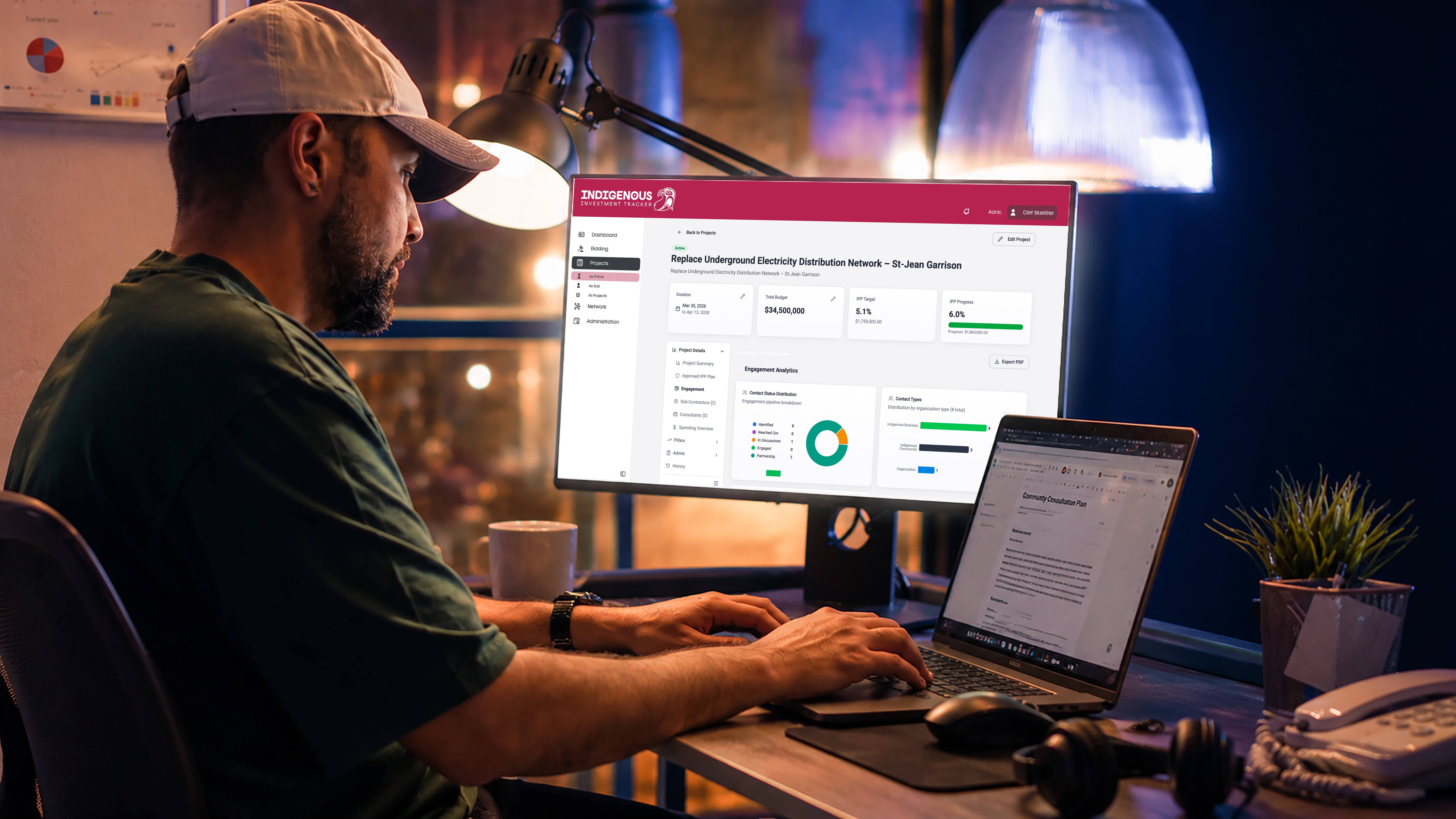
The reason we built the Indigenous Investment Tracker was simple. We got tired of seeing Indigenous Participation Plans treated like promises instead of systems.
The best participation plans are not built on hope. They are built on measurement.
Because whether you are trying to qualify for the World Cup or deliver meaningful Indigenous participation on a major infrastructure project, the formula is remarkably similar: build the pathway, track the results, keep score, and then improve the system until the opportunities become impossible to miss.
Let’s stop making the mistake my former friend made and instead put the goal in the right net.
"If you want to know where you're going, look where your feet are taking you." Indigenous Proverb